
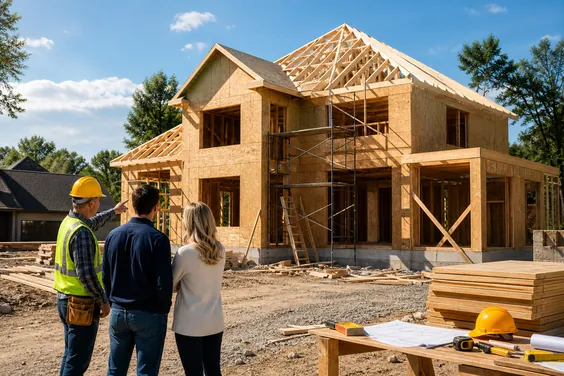
Builders risk insurance covers a home while it’s being built, renovated, or added to. Your homeowners policy covers the finished home. Two policies, two jobs. Lenders know the difference and want the right one before funds release.
For the technical breakdown of how the two policies differ, the vs homeowners insurance comparison goes deeper.
Do you need it?
Buy builders risk if any of these describe your project:
- You’re building a new home from the ground up.
- You’re adding square footage: a second story, an addition, an ADU.
- Your renovation will exceed roughly 25% of the home’s current value.
- The home will be empty for any real stretch of the build.
- Your loan papers require it. Most do.
You can skip a separate policy if:
- You’re doing minor repairs your homeowners policy already covers.
- You’re replacing a roof, fence, or driveway with no structural change.
- You’re staying in the home through a small remodel and your insurer has confirmed in writing they’ll continue coverage.
Even on smaller projects, call your homeowners carrier and ask. Get the answer in writing before you start. Cheaper than learning it after a fire.
Start a homeowner builders risk quote →
Why your homeowners insurance won’t work
Homeowners policies (HO-3 in carrier language) are written for finished homes. They include narrow built-in coverage for “dwelling under construction,” but the limits sit well below construction value and the conditions are tight.
Three things break the policy during a build.
First: occupancy. HO-3 forms include a vacancy clause that triggers after 30 to 60 consecutive days. Once it triggers, theft, vandalism, water damage from broken pipes, and most non-fire perils drop out. Move out for a renovation, the clause kicks in. Most homeowners doing serious work move out. This is the one that catches them every time.
Second: the work itself. HO-3 pays for damage to the finished structure. Materials waiting on site to be installed are not the structure. Your $40K of cabinets in the garage? Not covered. Plumbing fixtures rough-set but not yet inspected? Not covered. A partial second story damaged by wind before the roof goes on? Outside the policy.
Third: what your carrier will tolerate. Many drop the HO-3 entirely on a home in a major project. USAA has been known to push customers toward landlord-style policies for long renovations. Some carriers offer renovation riders with limits well below construction value. Some non-renew once the project crosses $250K or 25% of dwelling value. Wholesale carriers that homeowners’ insurers refer them to sometimes decline cost-plus contracts on principle. All four versions show up in homeowner conversations regularly.
Builders risk solves all three. It covers the structure, the materials, and the work in progress for the full construction term. Your homeowners policy picks back up when the project finishes. The full full coverage breakdown.
What your lender needs to see
Your loan papers spell out exactly what the certificate has to look like. Three things are non-negotiable, and lenders rarely waive any of them.
The mortgagee clause
The lender’s name has to appear with specific legal language. The processor reviewing your COI is scanning for this exact pattern:
[Lender Legal Name], ISAOA ATIMA
[Lender Mailing Address]
ISAOA ATIMA stands for “Its Successors and/or Assigns As Their Interests May Appear.” Without it, the certificate gets kicked back. We pull the exact language from the loan papers during the application so the certificate lands right the first time.
The policy term
Coverage has to run the full construction period plus a buffer. Contractor estimates 9 months? Buy a 12-month policy. Builds run long. Replacing the policy mid-project costs more than buying right up front.
The basis and limit
Replacement-cost basis, set at the finished value of the home. Lenders want replacement cost, almost without exception. Loan of $600K, land worth $200K? Construction value is $400K, and that’s typically what the limit needs to match or beat. Soft costs (architect fees, permit fees, loan interest during a covered loss) sometimes count toward the limit and sometimes get added by endorsement.
Once the policy is bound, BuildersRiskNerd sends the certificate directly to you and to the lender’s loan processor. Most lenders accept it within 24 hours. Some hold the first draw until the certificate lands on file, so we line this up before closing. The Federal Reserve consumer guide to construction loans is a clean primer on draw timing.
[Sample certificate of insurance image: mortgagee clause, named insured, policy term, and replacement-cost limit highlighted.]
Coverage when the homeowner is the named insured
When you’re the named insured on the builders risk policy, not your general contractor, the policy responds to your interest in the project first. This is the standard setup when you’re financing the project, you signed the construction contract, and your name is on the title.
What’s typically covered on a homeowner-named policy:
- The structure under construction, including existing portions if you’re doing an addition.
- Materials on the job site, and usually materials in transit.
- Materials stored at an approved offsite location, often with sublimits.
- Theft and vandalism on the unoccupied job site.
- Wind, hail, fire, and most weather perils. Named storm and earthquake usually require separate endorsements.
- Soft costs: architect fees, permit fees, loan interest during a covered loss, when added by endorsement.
What you’ll add by endorsement or live without:
- Faulty workmanship by the contractor. That belongs to the contractor’s general liability, not your policy.
- Wear and tear. Mechanical breakdown of installed equipment.
- Earth movement, flood, and named storm in coastal markets. Separate policies or endorsements required.
- Damage caused by employee dishonesty or off-job-site vehicles.
- Existing structures not part of the project, on some forms.
Named insured matters here. A homeowner-named policy treats you as the primary party with insurable interest. Your general contractor gets added as an additional insured so they have legal standing on a claim. The policy responds first to your loss. Compare that to a contractor-named policy. The GC holds it and you’re sometimes added as additional insured. Either structure can work for a project. Lenders usually prefer the homeowner-named form. Their loan is on your title.
If you’re acting as your own general contractor, the picture shifts again. Most standard markets decline owner-builder builders risk because the owner-as-GC role removes the safety net a licensed GC normally brings. The page on owner-builder builders risk covers what to expect when you’re running the project yourself.
What homeowner projects typically cost
Premiums are priced off three things: completed project value, construction term, and the type of work. Rates run between 0.2% and 1.0% of construction value. Most residential projects land between 0.4% and 0.7%.
What we see for homeowner projects:
Renovations and additions ($50K to $300K construction value): $400 to $1,200 for a 6 to 9 month policy. Bathroom and kitchen remodels at the lower end. Whole-house gut renovations and structural additions at the upper end.
New home construction ($300K to $1.5M construction value): $1,500 to $4,000 for a 12-month policy. Custom builds with high-value finishes can run higher. Production-style builds in stable markets land low.
Three factors do most of the work in pricing.
Construction value comes first. Higher value, higher premium.
Construction term comes second. A 12-month policy costs more than a 6-month one, but doubling the term doesn’t double the premium. Most of the loss exposure happens early, in framing and shell stages.
Location comes third. California wildfire zones, Florida named-storm zones, and Texas hail country all carry surcharges. Rural lots far from a fire station also rate higher.
Three things barely move premium: your credit score (usually doesn’t apply to builders risk), prior homeowners claims (different coverage, different rating), and whether the project is your primary residence or a second home (small rate difference, not a deal-breaker).
Most homeowner builds we quote land inside the bands above. The builders risk insurance cost page has the full breakdown of rating factors and example premiums by project type.
Three project types we cover
New home construction
Building from the ground up, typically $300K to $2M construction value. Coverage runs 12 months at minimum, with extensions if the project goes long. Soft costs and dwelling under construction limits make up most of the policy.
New home construction coverage details →
Major renovation
Gut remodels, structural changes, second-story additions, full-permit ADU conversions. Existing-structure coverage and vacancy handling are the differentiators. The renovation form is different from the new-construction form, and that matters.
Renovation and remodel coverage →
Owner-builder projects
You’re running the project as your own general contractor. Standard markets often decline these placements. BuildersRiskNerd works with carriers that have appetite for owner-builder when the homeowner has clear construction experience or strong oversight in place.
Owner-builder builders risk coverage →
How to quote through BuildersRiskNerd
About five minutes online or on the phone. We need the project address, the construction value, the start date, the construction term, and the lender’s mortgagee clause language. We come back with options from carriers that match the project. If something is bindable today, the certificate can be on the lender’s desk before the first draw.
BuildersRiskNerd places policies through admitted and non-admitted carriers depending on what fits the risk. We’re a broker, not an insurer.
Get my homeowner builders risk quote →
Frequently asked questions
Do I need builders risk insurance as a homeowner?
Yes if your project involves new construction, an addition, or a major renovation that goes beyond what your homeowners policy covers. Your construction lender will almost always require a builders risk certificate before releasing draw funds. Smaller cosmetic projects under about $10K usually don’t need a separate policy, but confirm with your homeowners carrier in writing before assuming coverage applies.
How long does builders risk coverage last?
A standard policy runs the construction term, commonly 6, 9, or 12 months. Extensions are available when projects go long, but they cost more than getting the right term in the first place. Coverage ends when the project finishes and the home is occupied, at which point your homeowners policy takes over.
Will my lender accept your certificate of insurance?
Lenders accept builders risk certificates from admitted and non-admitted carriers as long as the certificate names them with the ISAOA ATIMA mortgagee clause and the policy meets the loan agreement’s coverage minimums. We pull the lender’s exact mortgagee language during the application so the certificate is right the first time.
What if I’m acting as my own general contractor?
Owner-builder builders risk is a different placement story than a project run through a licensed GC. Most standard carriers decline owner-builder risks. We work with markets that have appetite for owner-builder when the homeowner has clear construction experience or strong oversight in place. The owner-builder builders risk FAQ walks through what carriers look for.
Can I buy builders risk after construction has already started?
You can, but options shrink fast. Most carriers want the policy bound before work begins, not after. Some will decline a project entirely if framing is already up. The cleanest path is to bind coverage before any work begins. If construction has already started, get on the phone the same day.
What happens to coverage when the project finishes?
The builders risk policy ends at completion. Some policies define completion as the certificate of occupancy, others as the date construction stops or the home is occupied. Your homeowners policy needs to be in force on the day the builders risk ends. Coordinate the timing with both your homeowners carrier and your lender so there’s no gap between the two policies.
Authoritative references: the NAIC consumer alert on home construction insurance, the Insurance Information Institute on home renovation insurance, and the NAHB on owner-built home considerations all provide useful background reading on the construction insurance landscape from a consumer perspective.
BuildersRiskNerd is a brand of ContractorNerd Insurance Services, LLC, a licensed insurance producer (CA License #6015566). All insurance products and services are offered through ContractorNerd Insurance Services, LLC. We’re a broker, not an insurer. Policies are underwritten by admitted and non-admitted carriers. The information on this page is for general guidance only and is not a binding quote or contract. Coverage depends on the policy issued.