
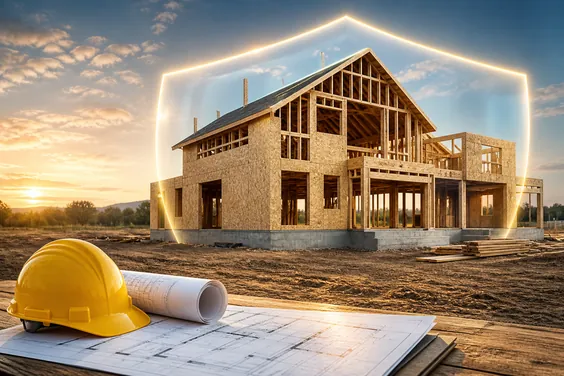
Bare lot today. Finished building twelve months from now. Builders risk is what protects everything in between. We’ve shopped these policies for custom home builders, spec developers, owner-builders, and commercial GCs on projects from $200K to $40M in all 50 states. Coverage is placed through A-rated specialty carriers that focus on course of construction risk.
What new construction builders risk actually covers
New construction builders risk covers a building from groundbreaking through certificate of occupancy. The policy starts at zero and grows with the project as materials hit the site and labor goes in. It works differently than policies for renovation projects, where there’s an existing structure to insure from day one. Some lenders call this course of construction insurance, but the two terms mean the same thing. The full overview lives on our builders risk insurance hub, so this page sticks to what’s specific to ground-up.
Two policy forms show up on new construction. Most projects use one of them.
Completed-value form is what most new construction policies use. You insure the project for its full final value on day one, even though most of that value is still sitting at a lumberyard. The carrier knows the building grows from foundation to finished structure over 6 to 18 months, and the form is built for that progression. You pay premium on the full completed value, and the carrier discounts it because exposure starts at zero and ramps up.
Reporting form shows up more on large commercial portfolios. You report the value at risk monthly and premium adjusts. It works for projects where construction value is hard to pin down at bind, but it asks for monthly reporting discipline most builders skip.
For a typical custom home or spec build, completed-value is the right call. Simpler. Premium is locked in. The lender certificate is cleaner.
What gets covered on a new construction policy:
- The structure as it goes up: fire, lightning, wind, hail, vandalism, theft, and most weather perils
- Materials on site, in transit, and in temporary off-site storage at covered locations
- Foundations, footings, and underground utility runs (often with sub-limits)
- Soft costs (with the right endorsement): extended loan interest, permit fees, lost rents on a project meant to lease
What sits outside the policy: liability for injuries on site (the GC’s general liability handles that), earthquake and flood (separate endorsements or standalone policies), mechanical breakdown after install, workmanship defects or design errors (LEG 3 or DE3 endorsements close the gap for sophisticated buyers), and existing structures since there are none on a true ground-up build. The Insurance Information Institute’s overview of new home construction coverage walks through the consumer-side framing if you want background.
Phase-by-phase risk profile
New construction is not one risk. It’s five. The exposure changes as the building goes up, and carriers price each phase differently. A bare slab is a different underwriting story than a framed shell, which is different again from a finished interior. The International Code Council’s guidance on construction phases maps the inspection points. Here’s how the insurance risk shifts at each one.
Site prep and foundation
Open lot. Bare slab. Little vertical structure to burn or blow over. The risk here is theft of equipment, fuel, and copper wire from temporary service drops. Vandalism shows up too, especially on lots near roads or with poor lighting. Frequency is moderate, severity is usually low. Most claims at this stage involve missing tools, stolen materials, or graffiti on the formwork.
Framing and dry-in
Fire risk peaks here. Walls go up. The framing is exposed lumber. One hot work mistake or a discarded cigarette can take the whole job. Weather exposure is also at its worst, since the building is up but still open to the sky. A wind event during framing can collapse partially completed walls and trusses. Carriers pay closest attention to fire prevention plans during this phase.
Mechanical, electrical, and plumbing rough-in
Water damage takes over. Plumbing lines pressurize for testing. A failed connection floods three floors before anyone shows up in the morning. Copper theft is a real story too, especially in markets where copper prices are high. Subs come and go through the day, the building stays mostly secured, and a high-value commodity sits inside the walls in plain sight.
Drywall and finishing
Building is closed in. Fire risk drops. Now the worry is theft of installed fixtures. Cabinets, faucets, light fixtures, hardware, built-ins. They all have street value and they sit inside a building before alarms get wired. Finish work also brings hot work back in. Floor finishers, foam insulators, and finish trades create new fire pathways the framing crew never had to worry about.
Final and punch-out
Appliances arrive. Final fixtures go in. The job is days away from a certificate of occupancy. This is when theft of high-value items peaks. Carriers see claims for stolen ranges, washers, dryers, and even installed countertops cut out and removed. Vandalism right before COO is surprisingly common, often from disgruntled subs or random opportunists who spot an empty new build sitting unattended.
Custom home vs. spec build vs. commercial new construction
Three buyer types show up for new construction builders risk. The policy structure changes for each.
Custom home buyers are homeowners who hired a GC to build a residence on a lot they own. The named insured is the homeowner. The lender requires a certificate of insurance with the bank as mortgagee. The GC gets added as additional insured. Most of the buyers BuildersRiskNerd quotes here land between $400K and $2.5M in completed value, on a 9 to 12 month term. A typical case: a couple in Austin building a $850K custom home with a regional bank construction loan, GC handling all the trades. If you’re the homeowner, our homeowner-side builders risk details walks through the buyer-side details. If you’re the GC and the homeowner is asking you to carry coverage, that’s a different product (a contractor builders risk program) that we can route you to.
Spec builders are GCs or developers building on speculation, planning to sell when the project is complete. The named insured is the builder. The buyer is the next person to walk the lot, so the lender on the construction loan is the mortgagee at bind. Spec builds tend to come in groups (a builder might have five lots active at once), and many carriers offer master programs that cover all open lots under a single policy. We typically refer dedicated spec builders with multiple active lots to a contractor program that prices better than per-project policies. If that’s you, mention volume on the application and we’ll route accordingly.
Commercial new construction is everything else: apartment complexes, retail centers, offices, light industrial, hotels, mixed-use. The named insured is the project owner or developer. Coverage limits run higher (we routinely place projects in the $5M to $50M range), terms run 12 to 24 months, and endorsement stacks are deeper. Commercial projects almost always need soft costs coverage, delay in opening, and ordinance and law. Lender requirements are also more detailed, with specific language often required in the certificate.
If you’re managing the build yourself rather than hiring a GC, the owner-builder builders risk details has the buyer-side details for that scenario, since the underwriting story is different again.
Coverage duration for new construction
Most residential ground-up projects bind a 9 to 12 month policy. Commercial projects bind 12 to 18 months, sometimes 24. The term should match the construction schedule, since builders risk ends at certificate of occupancy or beneficial occupancy, whichever comes first.
Here’s the catch: 60% or more of residential projects run past their original timeline. Permits hang up. Inspections slip. Materials run late. The building that was supposed to finish in October is still missing trim work in February. Plan for an extension before you bind.
Most carriers allow extensions in 90 day increments at pro-rated premium, but extensions need to be requested before the original term expires. The carrier has to agree, and the project has to be in good standing. If a project is going to run very long, the better play is often to bind a 12 month policy at the start and extend later, rather than binding 6 months and trying to add 6 more. A few carriers offer automatic extension provisions that add 30 to 90 days at no additional premium. Worth asking about on commercial work where critical path delays are common.
Lender requirements for new construction
If you’re financing the build with a construction-to-permanent loan, the lender wants the builders risk certificate in hand before releasing the first draw. The lender’s specific requirements vary, but most ask for the lender named as mortgagee, coverage equal to or greater than the loan amount, 30 to 60 days notice of cancellation, mortgagee endorsement language that pays the lender first if a claim hits, and proof of coverage submitted before each draw on some loan structures.
For C-to-P loans the certificate also needs to anticipate the conversion. Most lenders want the builders risk to stay active until they receive the homeowner’s standard policy. The transition happens at certificate of occupancy, and getting the timing right matters. Bind the homeowner policy too late and you have a coverage gap. Bind it too early and the homeowner policy may decline coverage because the building wasn’t occupied at bind.
If your project is cash-funded, you skip the lender certificate. Most owners still buy builders risk anyway, since the alternative is bearing 100% of the loss if the building burns or blows down before COO.
Cost expectations for new construction
Premium for new construction builders risk usually lands between 1% and 4% of total project value, with most residential projects in the 1.5% to 2.5% range. A $600K custom home in a typical state with no major catastrophe exposure runs roughly $1,500 to $3,000 for a 12 month term. A $5M commercial project in the same state runs $25K to $75K, depending on construction type, term length, and endorsements. National construction cost benchmarks from NAHB help validate completed values when the contract is light on detail.
The variables that move the number most: location (California wildfire zones, Florida and Gulf Coast wind, coastal Northeast all price higher), construction type (wood frame is more expensive than steel or masonry), term length (12 months costs more in absolute terms, less per month), endorsements (soft costs and theft sub-limit increases add real premium), and project value (larger projects often see lower percentage rates).
The full pricing breakdown lives on our builders risk pricing page, with state-by-state ranges and endorsement detail. For a quick read on what your project will cost, the fastest path is the BuildersRiskNerd quote tool.
When to add endorsements on a new construction policy
Most ground-up projects need at least one or two endorsements beyond the base form. The ones we add most often:
- Soft costs for any project with a construction loan, especially commercial. This pays the financial losses (extended loan interest, additional permit fees, lost rents) when a covered loss delays completion.
- Theft sub-limit increase for any project with copper-heavy MEP rough-in or appliances staged on site. Base form theft limits are often too low for a fully fitted kitchen.
- Ordinance and law for any project where current codes are stricter than the original design assumed. After a partial loss, code can require costly upgrades to the rebuild.
- LEG 3 or DE3 for sophisticated commercial buyers concerned about defective workmanship costing more than the trade’s warranty covers.
Two scenarios where you can stay basic: a small ADU under $200K with simple finishes, or a barebones commercial shell with no appliances or fixtures at risk. The full breakdown of endorsements for ground-up builds covers what each one does and what it adds in premium.
Common mistakes on new construction policies
Across the projects BuildersRiskNerd shops in a typical year, the same three mistakes show up over and over.
Underinsuring the completed value. Owners insure for the contract amount, then change orders push the project 15% over budget, and the policy limit lags the build. Insure to the realistic completed value, not the optimistic one.
Letting the policy lapse during a delay. Projects run long, the renewal date comes and goes, and nobody renews because the build is “almost done.” A burned-down building two weeks before COO is still a total loss.
Mismatched named insured. The most common version is a project where the homeowner owns the lot but the GC bought the policy in the GC’s name. When a claim hits, the homeowner has no policy and the GC has no insurable interest. Always name the party with the financial stake at risk, then add others as additional insured.
How to quote a new construction project through BuildersRiskNerd
Tell us about the project on our quick quote form. We need the address, the completed value, the construction start date, the expected completion date, the construction type, and basic contact info. We come back with quotes from carriers that fit, usually same day for residential, 24 to 48 hours for commercial. No premium commitment to get the quote.
Frequently asked questions
Does new construction builders risk cover the foundation? Yes. The foundation is part of the structure under construction and is included in the base form. Some carriers apply a sub-limit for in-ground work, so confirm the limit if you’re pouring deep foundations or basements.
When does new construction coverage start and end? Coverage starts on the bind date you pick, often the day materials first arrive on site (some carriers want coverage active before any materials are delivered). Coverage ends at certificate of occupancy or beneficial occupancy, whichever comes first.
Can the builder buy new construction coverage instead of the homeowner? Only if the builder has insurable interest. On most custom homes, the homeowner owns the lot and pays the construction draws, so the homeowner has the insurable interest and should be named insured. The builder gets added as additional insured. On spec builds, the builder owns the project and is named insured.
Does new construction builders risk cover tools and equipment? Materials scheduled for installation are covered. Tools and equipment owned by the contractor belong on a contractors equipment policy or an inland marine endorsement.
Can I get builders risk coverage if construction has already started? Sometimes, but it gets harder fast. Most carriers want coverage bound before any materials are on site or before the foundation is poured. Once framing is up, options narrow. BuildersRiskNerd can still shop the project, but expect fewer carriers willing to quote and higher premiums than you would have paid if coverage was bound at the start.
BuildersRiskNerd is a brand of ContractorNerd Insurance Services, LLC, a licensed insurance producer (CA License #6015566). All insurance products and services are offered through ContractorNerd Insurance Services, LLC. We’re a broker, not an insurer. Policies are placed with admitted and non-admitted carriers.