
BuildersRiskNerd shops Texas builders risk through admitted carriers, surplus lines markets, and TWIA-paired wind coverage in all 14 Tier 1 coastal counties.
BuildersRiskNerd is a brand of ContractorNerd Insurance Services, LLC (CA License #6015566), a licensed insurance producer. Tell us about the project. We come back with quotes from carriers that fit.
Get a Texas builders risk quote Tell us about the project. We shop admitted carriers and surplus lines markets, plus TWIA wind for coastal builds. Same-day quotes for inland Texas. Lender-ready certificate the day the policy binds. Start a Texas quote →
What Texas builders risk covers
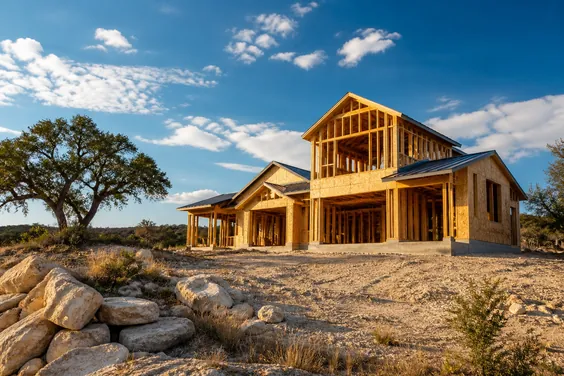
Builders risk in Texas covers a structure under construction against fire, theft, vandalism, wind, and hail until the project is complete. The base coverage form is similar to what a Florida or California contractor would see. What changes in Texas is the wind handling on the coast, the 4.85% surplus lines tax, the DFW hail loadings, and Hill Country wildfire underwriting.
This page covers Texas-specific regulation, market, and pricing. For the underlying coverage form and standard exclusions, see what a builders risk policy covers.
Texas regulations: TDI, surplus lines tax, and disclosures
The Texas Department of Insurance (TDI) regulates builders risk in the state. Admitted carriers file their builders risk forms with TDI through ISO or proprietary forms, and rates have to be on file before a carrier can quote in Texas.
When a project goes to the surplus lines market, the math changes. Texas charges a 4.85% surplus lines premium tax on gross premium, plus a 0.04% stamping fee paid to the Surplus Lines Stamping Office of Texas. Both pass to the insured as line items on the invoice. So a $5,000 annual builders risk premium picks up about $244 in tax and $2 in stamping fees on top.
A surplus lines policy in Texas also carries a disclosure on the policy itself: that the carrier is not licensed in Texas, TDI does not audit its solvency, and the policy is not protected by the state guaranty association. This is statutory boilerplate. It does not change the certificate the lender sees.
Most coastal builders risk and a lot of higher-hazard inland projects place in the surplus lines market. Standard new builds in Houston, Dallas, Austin, and San Antonio with wood frame construction and no flood exposure typically place admitted. Once you add wildfire exposure, coastal wind, vacant rehab, or a non-standard project, surplus lines is usually where the quote comes from.
The other Texas-specific item: TDI sometimes treats renovation and ground-up under different filings. You don’t see this as a buyer. But it is why two carriers can have very different appetites for the same project depending on whether the work is a new home on a vacant lot or a rebuild behind existing walls.
Coastal counties and the named-windstorm exclusion
Texas has 14 Tier 1 coastal counties: Aransas, Brazoria, Calhoun, Cameron, Chambers, Galveston, Jefferson, Kenedy, Kleberg, Matagorda, Nueces, Refugio, San Patricio, and Willacy. Parts of Harris County east of Highway 146 sit in Tier 2 and get treated similarly. If your project is in any of these areas, the wind story drives almost everything about the premium.
Most builders risk carriers in Texas exclude named windstorm in Tier 1 counties. A hurricane, tropical storm, or any storm the National Hurricane Center has named is not covered under the base policy. Plain wind and hail from a non-named event might still be covered. Once NOAA assigns a name, the project is on its own unless a separate solution is in place.
There are two solutions.
The first is the Texas Windstorm Insurance Association (TWIA), the residual market for wind and hail in the designated catastrophe area. TWIA was created after Hurricane Celia hit Corpus Christi in 1970 and the private market pulled out. To qualify, the project has to be denied by at least one private carrier, sit inside the catastrophe area, and meet TDI windstorm building code requirements. New construction in Tier 1 counties has to carry a WPI-8 Certificate of Compliance from a TDI-appointed inspector during the build. Without that certificate, the property cannot get TWIA wind coverage at completion. Builders who do not plan for the WPI-8 inspection schedule get bitten by this.
The second is a wind endorsement layered onto the builders risk policy through a surplus lines carrier with appetite for coastal wind. The loaded premium can run 3 to 5 times what an inland Texas builders risk would cost on the same total insured value.
A typical coastal stack: builders risk on the structure (fire, theft, vandalism, water, non-named wind), TWIA on the structure for named storms, and a flood policy through NFIP or private flood if the lot sits in a SFHA. Three policies, one project. The lender will accept the stack as long as all three certificates show A-rated paper and the insured value matches the contract or appraisal.
For more on the endorsements that change wind and hail handling, see wind and hail endorsements.
North Texas hail and tornado exposure
The DFW metro is one of the highest hail-loss zones in the country. Tarrant, Dallas, Denton, Collin, and Johnson counties take large hail events almost every year. A single April 2021 storm in DFW caused over $1 billion in insured losses. Builders risk underwriters know this and price accordingly.
Carriers do not usually exclude hail in DFW the way they exclude named wind on the coast. They build the cost into the rate. A new build in Frisco with composition shingles often quotes 30% to 50% higher than the same project in Lubbock or El Paso, almost entirely because of hail exposure.
The bigger pain point on a project under construction is timing. A roof mid-installation, with felt down but no shingles, takes more damage per inch of hail than a finished roof. If your framing is done and the deck is sheathed but not yet covered, a 2-inch hail event can total the deck. Builders risk covers it. The deductible does not.
Some North Texas builders risk policies run a separate wind/hail percentage deductible (1% to 5% of TIV) on top of the AOP deductible. On a $500,000 project that is $5,000 to $25,000 out of pocket on a single hail claim. Worth asking about before binding.
Wildfire risk in Texas Hill Country
Wildfire used to be a West Texas and Panhandle problem. Now it is a Hill Country problem too. The Bastrop County Complex Fire in 2011 burned more than 1,600 homes east of Austin. Drought cycles, urban-wildland interface growth, and cedar fuel loads have made counties like Bastrop, Hays, Travis, Comal, and Burnet a real underwriting concern.
Carriers evaluating Hill Country builders risk now ask about defensible space (typically 30 to 100 feet around the structure), Class A roofing, ember-resistant vents, and proximity to the nearest fire department. Projects within a half-mile of heavy cedar or oak fuel can trigger surcharges or a referral to surplus lines.
A $750,000 custom build in West Lake Hills or Dripping Springs might quote admitted at 1.2% of value if defensible space and Class A roof are confirmed. The same project on a forested slope in Burnet County, lot recently cleared but heavy fuel within 50 feet, often quotes E&S only at 2.0% to 2.5% of value with a separate wildfire deductible.
Which carriers cover Texas builders risk
A few things to know about the Texas market.
Texas Mutual is the state’s largest workers comp carrier. They do not write builders risk. Mention only because contractors sometimes confuse the two when they hear “Texas Mutual” and assume it is a property carrier.
Texas Windstorm Insurance Association (TWIA) is the residual market for coastal wind and hail. TWIA is not a standalone builders risk option. It is a wind-only policy that pairs with a private builders risk to fill the named-storm exclusion in Tier 1 counties. A.M. Best rates TWIA A (Excellent), so the certificate clears most lender requirements.
Admitted builders risk carriers active in Texas include Zurich, Travelers, Liberty Mutual, Nationwide, and Chubb. These markets quote standard inland new construction, residential remodels, and most commercial ground-up projects. Their appetite shrinks fast when wildfire, coastal wind, or vacant rehab enter the picture.
Surplus lines carriers active in Texas builders risk include Lloyd’s syndicates, Markel, Western World, Lexington, RLI, and Aspen. These are the markets BuildersRiskNerd shops most often for Tier 1 coastal projects, Hill Country wildfire-exposed builds, and any project where the admitted markets pass.
The lender does not care which bucket the policy comes from. They care that the carrier is A.M. Best A-rated, the policy form covers the structure, and the certificate names them as mortgagee or loss payee. All of the carriers above clear that bar.
Average cost of builders risk in Texas
Texas builders risk premiums fall into three rough bands based on geography and peril exposure.
Inland Texas (most of the state outside DFW hail zones, Hill Country wildfire zones, and Tier 1 counties): 1.0% to 2.0% of TIV annualized. A $400,000 new construction project in San Antonio or El Paso typically prices in the $2,000 to $3,200 range for a 9-month term, including the surplus lines tax if applicable.
DFW hail zones (Tarrant, Dallas, Denton, Collin, Johnson, parts of Rockwall and Ellis): 1.5% to 3.0% of TIV. A $500,000 ground-up in McKinney runs $3,750 to $7,500 for a 12-month term. Adding a 3% wind/hail percentage deductible can knock 20% to 30% off the premium.
Tier 1 coastal counties: 2.5% to 6.0% of TIV with the wind solution stacked on. A $300,000 new home build in Galveston commonly looks like a $4,500 builders risk policy (excludes named wind), plus a $5,000 to $8,000 TWIA wind policy. Total stack: $9,500 to $12,500 for a 12-month term, before surplus lines tax.
These ranges are real but every project has variables. Wood frame versus masonry, sprinklered or not, vacant lot versus existing structure, project term, and whether the GC has clean loss runs all move the number.
For a deeper look at what drives premium, see how project location moves cost.
How to buy builders risk in Texas
Start a quote at BuildersRiskNerd. We need the project address, scope, total construction value, term length, GC name, and lender info if there is one. Coastal projects need WPI-8 status and TWIA application timing if wind is going through TWIA. Hill Country projects need defensible space and roofing class. Inland standard projects do not need anything extra.
We shop the project to admitted carriers first when the risk fits, surplus lines when it does not. Most quotes come back same day or next morning. Coastal projects with a TWIA stack take an extra 1 to 2 business days because of the wind agent of record and inspection coordination.
Once the policy is bound, the certificate goes to the lender same day. The invoice will show the carrier premium, the 4.85% Texas surplus lines premium tax (if surplus lines), the 0.04% stamping fee, and the broker fee if any. The tax line is set by statute. It does not go to the carrier or to BuildersRiskNerd. It goes to the Texas Comptroller.
Common mistakes contractors make on Texas projects
Six things to avoid.
Buying admitted builders risk on a Tier 1 coastal project and assuming wind is covered. The named-windstorm exclusion sits in the policy form. Read it. If wind is not separately addressed, the project is not covered for hurricane.
Skipping the WPI-8 inspection schedule on coastal new construction. Without the certificate, the completed property cannot get TWIA wind coverage. That makes the property hard to insure once the builders risk ends.
Underinsuring on coastal projects to dodge the wind premium. The lender checks. If the policy limit is below the contract value, the loan does not fund.
Ignoring the wind/hail percentage deductible in DFW. A 5% deductible on a $1M project is $50,000. That is a real number on a real claim.
Letting the policy lapse after the certificate of occupancy. Builders risk ends when the project completes, and a homeowners or commercial property policy needs to be in force the same day. A one-day gap is a real problem if a hailstorm hits.
Treating modular and manufactured home builds the same as site-built homes. Texas carriers handle modular and manufactured construction differently, and most admitted carriers either decline or carve out coverage during transit and set. Plan for surplus lines on those projects.
Frequently asked questions
Is builders risk insurance required in Texas?
Texas does not require builders risk by statute, but lenders almost always require it on financed construction projects. AIA contracts and most owner-builder contracts in Texas require it as well. Cash-funded jobs are the only common exception.
Does builders risk in Texas cover hurricanes?
Not in Tier 1 coastal counties under most policies. Carriers exclude named windstorm in those 14 counties, so a separate TWIA wind policy or a wind endorsement from a surplus lines carrier with coastal appetite is needed. Inland Texas projects typically have hurricane and tropical storm coverage included.
What is course of construction insurance in Texas?
Course of construction insurance is the same product as builders risk in Texas. The terms are interchangeable. Some carriers and lenders prefer “course of construction” on commercial projects and “builders risk” on residential, but the policy form is the same.
How long does a Texas builders risk policy last?
Standard terms are 3, 6, 9, or 12 months. Most Texas projects bind for 12 months with the option to extend in 3-month increments if construction runs long. Coastal projects sometimes bind for 6 months and renew due to wind market pricing volatility.
Who pays the surplus lines tax in Texas?
The 4.85% surplus lines premium tax is collected by the broker and remitted to the Texas Comptroller. It is passed to the insured as a line item on the invoice. The carrier does not keep it. The broker does not keep it.
Can I buy Texas builders risk online?
Yes. BuildersRiskNerd quotes Texas builders risk online for most inland projects. Coastal projects with TWIA stacks take an extra 24 to 48 hours because of the wind coordination, but the quote process starts the same way.
Ready to start a Texas builders risk quote? Tell us about the project. We come back with quotes from admitted carriers, surplus lines markets, and TWIA wind for coastal builds. Get a Texas quote →
Other states we cover: Florida builders risk insurance | California builders risk insurance | Massachusetts builders risk insurance
External references: Texas Department of Insurance | Texas Windstorm Insurance Association | Surplus Lines Stamping Office of Texas | NOAA Texas hurricane history
BuildersRiskNerd is a brand of ContractorNerd Insurance Services, LLC, a licensed insurance producer (CA License #6015566). All insurance products and services are offered through ContractorNerd Insurance Services, LLC. We are a broker, not an insurer. Policies are placed through admitted and non-admitted carriers.