
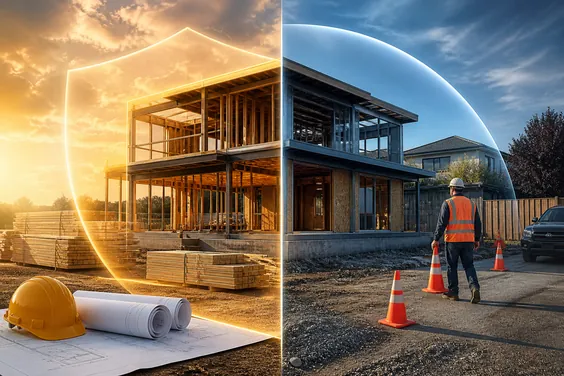
Builders risk insures the building. General liability insures the contractor when their work hurts someone else. Most active projects carry both, and contractors mix them up more than any other coverage question we get at BuildersRiskNerd.
BuildersRiskNerd is a brand of ContractorNerd Insurance Services, LLC, a licensed insurance producer. We’ve quoted builders risk for thousands of projects across all 50 states. Broker, not insurer.
The short answer
Builders risk insurance covers physical damage to a building under construction. General liability insurance covers a contractor’s legal liability when their work causes injury or damage to other people or other property. They are not the same policy. Most active construction projects need both.
| Factor | Builders Risk | General Liability |
| What it covers | Physical damage to the project, materials, and structure | Bodily injury and third-party property damage caused by the contractor’s work |
| Who is named insured | Owner, GC, and lender (often all three) | The contractor or trade business |
| When it’s needed | Project start through completion or first occupancy | Year-round, regardless of project status |
| Who pays | Owner usually, sometimes GC per the contract | The contractor, as part of operating costs |
| Typical cost range | 1-4% of total project value, annualized | $400 to $2,500 per year for most trades |
| When it ends | Completion, occupancy, or 12-month policy term | Annual renewal |
Get a builders risk quote in 5 minutes →
What builders risk covers
Builders risk is a property policy on the project. It pays when fire, wind, theft, vandalism, or other named perils damage the building under construction, the materials staged on site, and (often) materials in transit or temporary storage. Some forms run on an open-perils basis, where everything is covered except the specific exclusions listed.
The policy ends at one of three triggers: project completion, first occupancy, or the policy term limit. Twelve months is the common term on residential, longer on commercial. After that, a permanent property policy takes over. A homeowners policy on a house. A commercial property policy on a building.
Three things sit outside the BR form, every time. Employee injuries belong to workers’ comp. Tools and equipment owned by the contractor belong to an inland marine policy or a contractor’s tools floater. And any liability for harm to third parties belongs to general liability. Liability is the entire point of GL. That is why most projects carry both.
For the full breakdown of perils, exclusions, and which endorsements are worth adding, see what a builders risk policy actually covers. For the broader explainer on how builders risk works, the builders risk insurance overview.
What general liability covers
General liability is the contractor’s policy on the contractor’s risks. It pays when the contractor’s work, equipment, or premises cause bodily injury or property damage to someone else. The standard form is the ISO Commercial General Liability CG 00 01, used by most admitted carriers with their own modifications.
A standard CGL has four main coverage parts. Bodily injury and property damage pays when a passerby gets hit by falling debris, or when a sub’s torch sparks a brush fire next door. Products and completed operations pays for harm caused after the job is done, like a handrail you installed giving way and someone falling. Personal and advertising injury handles defamation and a few other claims that rarely show up on construction sites. Premises liability covers slip-and-falls at your shop or office. Four parts, one form.
The contractor is the named insured. Owners and GCs are typically added as additional insureds via endorsement when the contract requires it. That endorsement is what protects upstream parties when a sub’s accident escalates. Most prime contracts we see require it. The GCs that skip it find out at the first claim.
Five real scenarios that show the difference
Specifics make the line stick. Here are five claims we see often and which policy pays each one.
A fire mid-build destroys the framing
A $500K new home in Phoenix. Framing is up, dry-in scheduled for next week. A space heater left running overnight lights a stack of building paper in the garage. By morning, half the framing is charred. The materials staged inside are a total loss.
Builders risk pays. Fire is a covered peril on every BR form. The building is the covered property. The damage is direct physical loss. The settlement covers framing rebuild, debris removal, and the destroyed materials, subject to the deductible. GL stays out. No third party was harmed, no third-party property was damaged.
A worker drops a hammer onto a passerby
A roofer’s framing hammer slips out of his bags during a tear-off on a two-story remodel. It clears the safety netting, which wasn’t tied off properly, and hits a pedestrian on the sidewalk below. ER visit, concussion, a few weeks of missed work.
General liability pays. Bodily injury to a third party caused by the contractor’s operations. Textbook trigger on a CGL policy. The policy covers medical bills, lost wages, pain and suffering, and the contractor’s legal defense. BR stays out. It pays only for damage to the building itself.
A plumber installs a defective valve that floods the home after closing
A solder joint on a main shutoff fails six months after the homeowner moves in. The leak runs for three days while they’re on vacation. Hardwood floors warped. Cabinets ruined. Drywall through the first floor cut out and replaced.
General liability pays for the third-party property damage: the floors, cabinets, and drywall installed by other trades. Products-completed operations is the coverage part that responds. The plumber’s own work, the valve and the joint, sits inside the “your work” exclusion and stays uncovered. Builders risk ended at occupancy, so it stays out too. This is one of those places where reading your policy and endorsement schedule actually matters.
A subcontractor drives a forklift into the neighbor’s fence
A framing crew on a $1.2M custom build is moving lumber with a rented forklift. The operator backs up too quickly, jumps the property line, and takes out 30 feet of the neighbor’s wood fence. About $4,200 in damage.
The framing sub’s general liability pays. Third-party property damage caused by the contractor’s operations, a clean GL claim. If the GC was added as additional insured on the sub’s GL, which the contract should have required, the GC’s policy stays clean unless the sub is uninsured or under-limited. Builders risk stays out. The fence sits outside the project property.
Wind damage to dry-in framing
A spec home in Lubbock, Texas. The framers finish the second-floor wall on a Friday. A cold front blows through Saturday with 70 mph gusts. Sheathing peels off three walls. A section of framing bends out of true. Damage estimate: $32,000.
Builders risk pays. Wind is a named peril on essentially every BR form. The damage is to the project property. The project is in the policy term. Watch for two wrinkles. The wind deductible is often higher than the all-other-perils deductible, especially in tier-one wind counties. The named-storm deductible kicks in if a tropical system is involved. GL stays out. The damage is to the project, not a third party.
Why most projects need both
The two policies operate independently and answer different questions at claim time. Builders risk asks: is this damage to the project? General liability asks: did the contractor’s work harm someone outside the project? When the answer to either is yes, the right policy pays.
Most active projects carry both because the requirements come from different places. Lenders require builders risk before funding the construction loan, with the lender named as loss payee on the certificate. State licensing boards and project contracts (AIA A201, ConsensusDocs 200, most prime contracts) require general liability separately. The minimum limits we typically see: $1M per occurrence and $2M aggregate.
The certificate of insurance is where this plays out in the real world. The lender holds a COI for the BR policy with itself as loss payee or mortgagee. The project owner holds a COI for the GC’s GL with itself as additional insured. Same document format. Different carriers. Different policies. Different reasons. Send a single COI and assume it satisfies both, and the lender or owner usually catches it within a week and asks for the missing one.
Subcontractors typically carry their own GL and ride as additional insureds on the project’s builders risk. The GC’s GL covers the GC’s own risks and often picks up the GC as additional insured on each sub’s GL. Layered correctly, a single incident triggers the right policy without the parties fighting over coverage. On nearly every multi-trade project we touch, the GCs we quote run this layered structure with their subs. Owner-builders especially need both, since they sit in the position normally held by the GC and the project owner at once. See our the owner-builder builders risk overview for how that stacks up.
The two policies operate cleanly side by side. A GL claim leaves the BR limits intact. A BR claim leaves the GL aggregate intact. Each policy pays under its own terms. For a deeper look at which party is contractually required to carry each policy, see our breakdown of who pays for builders risk insurance.
How to buy both BR and GL
BuildersRiskNerd shops builders risk. We place coverage for new construction, renovations, owner-builder projects, and commercial builds with carriers that fit the project’s class, value, and term.
For general liability and other contractor coverages (workers’ comp, commercial auto, tools and equipment), we hand off to our sister brand ContractorNerd, the contractor-focused arm of the same producer. Same licensing, same team, same admitted and non-admitted markets. One submission gets you in front of both.
Some carriers will quote a bundled BR + GL package for owner-builders or single-project GCs. Bundles aren’t always cheaper, but they simplify the certificate and the renewal cycle. We’ll quote both when it makes sense and let you compare. See carriers that offer builders risk for which markets bundle and which don’t.
Start a builders risk quote → Tell us about the project. We’ll come back with quotes from carriers that fit, certificate-ready for the lender.
FAQ
Does builders risk cover liability?
No. Builders risk is a property policy on the project itself. It pays for physical damage to the building, materials, and structure under construction. Liability for injuries and third-party damage sits outside builders risk. That is the whole point of general liability.
Do I need general liability if I have builders risk?
Yes, in almost every case. Builders risk pays only for damage to the project. Any claim involving a person hurt on or near the site, or damage to property that isn’t part of the build, falls to general liability. Lenders require BR. Contracts and licensing usually require GL. Two different risks, two different policies.
Is general liability the same as builders risk?
No. The two policies cover different risks, and each handles a job the other cannot. Builders risk insures the building under construction. General liability insures the contractor’s legal exposure for harm to other people or property. Most construction projects carry both at the same time.
Which one does my lender require?
Builders risk, almost without exception. Every construction lender we work with requires it before funding draws, with the lender named as loss payee on the certificate. Some commercial lenders also ask for evidence of the GC’s general liability, but builders risk is the policy that protects the lender’s collateral, the building itself. Project owners and contracts often require GL on top of BR.
BuildersRiskNerd is a brand of ContractorNerd Insurance Services, LLC, a licensed insurance producer (CA License #6015566). All insurance products and services are offered through ContractorNerd Insurance Services, LLC. We’re a broker, not an insurer. Policies are underwritten by admitted and non-admitted carriers.
External references